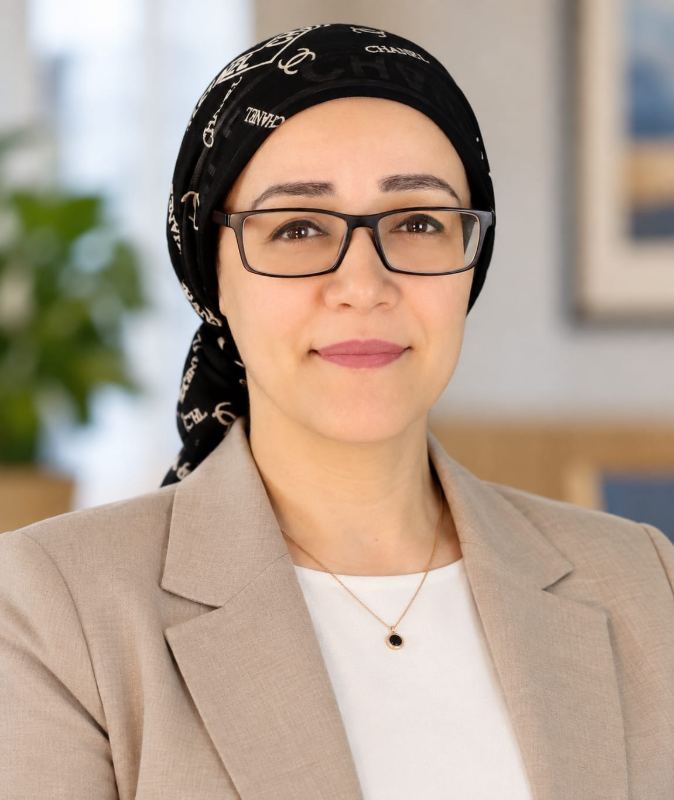
Dr. Heba Saleh
Director of Information Technology Institute
Egypt
About the Speaker
(LinkedIn)
Information Technology Institute (ITI), Egypt
Dr. Heba Saleh serves as the Head of the Information Technology Institute, one of the pillars of the Egyptian Ministry of Communications and Information Technology (MCIT) for developing the IT industry by preparing specialized Egyptian cadres in cutting-edge technologies with rapid demand in the local, regional, and global markets.
Supreme Council of Egyptian Universities
• Member of the Egyptian Computer Science Committee at the Supreme Council of Egyptian Universities
• Member of the Electronic and Knowledge Services Centre
• Board Member of Egypt University of Informatics (EUI)
• Board Member of the British University in Egypt (BUE)
• Board Member of Xceed
Dr. Heba Saleh graduated from the Faculty of Engineering at Cairo University in 1996, obtained her Master's degree in Computer Science from the University of Louisville in the United States, and earned her Ph.D. from the University of Sunderland in the United Kingdom in 2014, focusing on the quantitative and qualitative impact of using simulation and modelling technologies to develop learning skills.
Over a 20-year professional career, she has participated in:
• Implementing several presidential initiatives in the fields of human development, capacity building, and skills enhancement within information and communications technology (including the Technology Learning Initiative, the Localization of the Electronics Industry, and the Our Digital Future Initiative).
• Developing, formulating, and implementing the national strategy for human capacity building in Egypt's outsourcing industry sector within information and communications technology in general, and specifically in the electronics industry and freelancing sectors.
• Developing young cadres in the IT sector to serve the Suez Canal by designing the horizontal expansion policy of the Information Technology Institute and establishing its presence within the Suez Canal region as one of the pioneering initiatives to develop specialized cadres to serve this national project.
• Launching the "Mahara-Tech" digital online platform under the supervision of the Egyptian Ministry of Communications and Information Technology to provide specialized educational content in Arabic and English, alongside sign language, delivered by a group of experts across various fields to help Egyptian and Arab youth kick-start their journeys or upgrade their skills in IT fields.
• Regarding Arab cooperation, implementing numerous joint strategic cooperation programs with Arab countries focused on preparing, qualifying, and developing human capacities using distance learning technologies.
• Regarding African cooperation, implementing numerous joint strategic cooperation programs with African countries by establishing a mutual partnership focused on preparing and qualifying human cadres and developing African governmental capacities using distance learning technologies.
• Expanding the reach of the Information Technology Institute to encompass 22 branches and over 90 information centers across all governorates of the republic to prepare, qualify, and develop the capabilities of Egypt's youth, including university students and graduates.
• Publishing numerous academic papers and scientific publications in the fields of business intelligence, data mining, and information and communication technology practices for learning, modelling, and simulation.
• Contributing to community roles in women's digital awareness in cooperation with various national entities, as well as digital awareness and supporting the spirit of innovation for young children.
She possesses expertise and proficiency in:
• Managing multilateral international cooperation projects (governments, bodies, organizations, and corporations) in the field of human skills development.
• Contributing to the development, formulation, and implementation of several national ICT strategies for human capacity building.
• Localizing global cutting-edge technologies, expertise, and modern methodologies in human skills development.
• Transferring and simulating foreign initiatives in the field of human skills development.
• Managing crises and emerging risks within institutions.
• Managing digital online platforms to facilitate remote training.